
Engine · Chapter 4, Signals, Disclosure, and Persuasion
Persuasion by design
What can a committed test-designer make a sceptical audience believe?
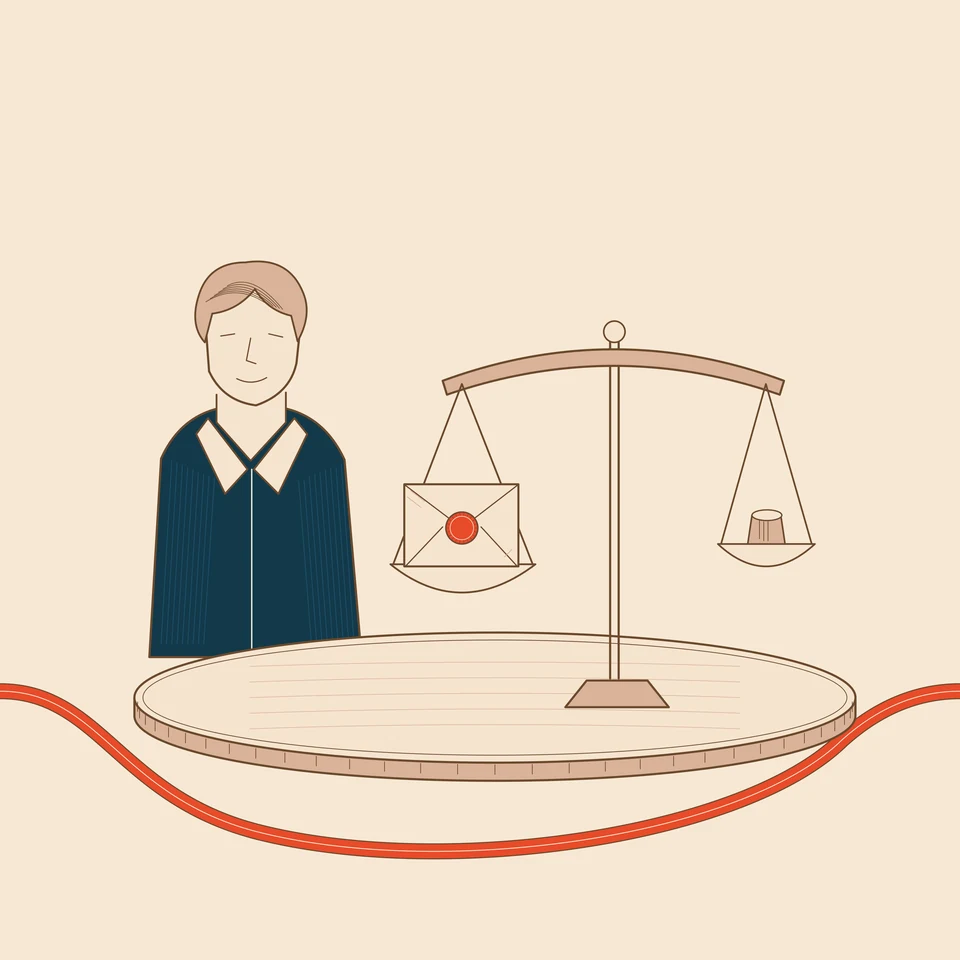
The situation
acts when its posterior reaches θ
The test
The book's scenario
How often the receiver acts
≈ 0.6000against with no test and under full disclosure. The sender's ceiling, the concave closure at the prior, is .
What the test does
| The test | pass of good cases, of bad ones |
|---|---|
| A pass | probability , posterior , receiver acts |
| A fail | probability , posterior , receiver does not act |
| Receiver's expected payoff | (no test: ; full disclosure: ) |
D The book certifies: pass of bad cases, action rate against under full disclosure, receiver's payoff against . Agreement, exactly.
The arithmetic
The receiver's payoff from acting at belief is , zero exactly at ; the optimal test leaves it with nothing because every pass lands on that line. Optimal share of bad cases passed: .
The model it runs
Model S1 · p. 168
How much action can a designed test produce, and at whose expense?
- 1Decision-makers
- sender (designs the test) and receiver (acts)
- 2Time
- the test is chosen before the state is realised; then the result is seen and the receiver acts
- 3Information
- endogenous: the sender's choice of experiment (field 6) determines what the receiver observes
- 4Commitment
- the sender commits to the test and cannot alter or hide its result
- 5Payoffs
- sender: if the receiver acts; receiver: as in Definition 4.1 (p. 168)
- 6Strategies
- binary tests (sufficient here); the receiver's rule is fixed by its threshold
Analysis contract
- (i) concept
- sender-optimal experiment against a best-responding receiver (commitment to an information policy)
- (ii) deviations
- all experiments: by Theorem 4.2 (p. 168) it suffices to consider distributions of posteriors
- (iii) beliefs
- Bayes' rule from the common prior
- (iv) selection
- the indifferent receiver acts (sender-favourable)
- (v) attainment
- attained; exact; checked against enumeration of two-posterior splits